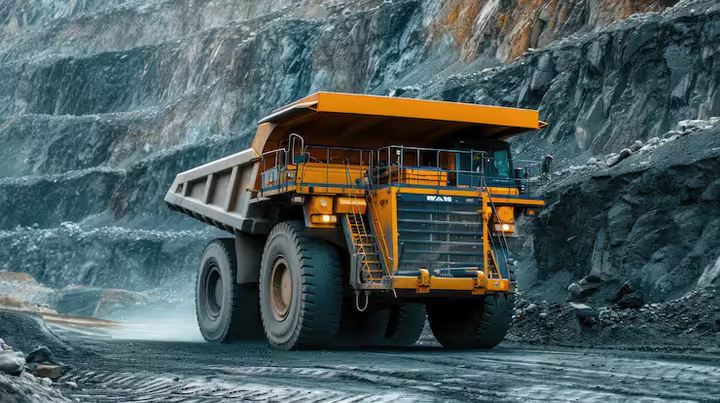
Autonomous Mining Trucks: How Intelligent Haulage Systems Work
Autonomous mining trucks are heavy vehicles used in mining to transport minerals, stone, soil and other materials, and under defined conditions they can operate without a human driver.
These vehicles use sensors, GPS, computer-based control, artificial intelligence (AI) and communication technology to identify their position at the mine site and move along a set route.
Conventional mining trucks need a driver. At large open-pit mining sites, trucks must continuously be taken to the loading point, driven along a designated route and delivered to the unloading point. This process involves driving for long periods and dealing with dust, rough roads and the movement of heavy vehicles.
An Intelligent Haulage System aims to make this operation automated and integrated. Information is exchanged between the trucks, route control, loading machines, haulage management software and a monitoring center. This technology is used especially in large open-pit mining projects, where planning vehicle movements and transporting material are important.
Main Types of Autonomous Mining Trucks
Autonomous mining trucks can differ according to their level of operation.
- Remotely controlled trucks: An operator drives the vehicle from a control center or another suitable location. The vehicle does not carry out the entire operation by itself.
- Semi-autonomous trucks: The vehicle performs some operations automatically, but human intervention is required in certain situations.
- Fully autonomous trucks: Within a defined operating area, the vehicle can move along the route, detect obstacles and control multiple stages of the haulage cycle. The actual level of autonomy depends on the system design and the conditions at the mine.
Core Purpose of an Intelligent Haulage System
The main purpose of this system is to make mining haulage more organized. It collects information about vehicle positions, road conditions, material loads and operating times.
Based on this information, the system can send vehicles along the appropriate route, coordinate their movement at the loading site and help deliver them to the designated unloading point. However, to run an autonomous system safely, suitable roads, communication arrangements and continuous technical monitoring are required.
Importance
Haulage is an important part of the production process in mining. Excavated material must be transported from the loading site to a crusher, stockpile or other designated location. If truck movement is delayed or congestion builds up on haul routes, other mining operations can also be affected.
Improvement in Safety
At mining sites, heavy trucks, excavators, bulldozers and other vehicles may work in the same area. Dust, low light, rough roads and limited visibility can increase the risk of accidents.
Autonomous mining trucks can monitor their surroundings using cameras, radar, LiDAR and other sensors. Depending on the system, the vehicle can detect obstacles, reduce speed or stop in a controlled manner. These capabilities can help reduce risk, but they do not guarantee that accidents will be prevented in every situation.
Haulage Efficiency
An intelligent haulage system helps plan the truck’s route, speed, loading time and unloading location. This can improve coordination between vehicles and reduce unnecessary waiting time.
The system can also analyze vehicle utilization, haulage cycles and operating records. This information is used for route management, maintenance planning and identifying operational delays.
Changes in Workforce Roles
When autonomous trucks are used, some of the responsibilities of traditional driving may change. Instead of directly operating vehicles, personnel may focus more on the control center, system monitoring, maintenance, data analysis and safety procedures.
This requires training personnel in digital controls, sensors, communication systems and the safety of autonomous vehicles. Implementing automation is not merely a matter of replacing vehicles; it can also change working methods and mine planning.
Recent Developments
Between 2024 and 2026, artificial intelligence, autonomous vehicles, digital monitoring and data-driven operations have continued to grow in importance in the mining industry. In large mining projects, intelligent haulage systems may be used to coordinate vehicles and collect operational data. However, implementation of the technology depends on the size of the mine, investment, road conditions and the available communication infrastructure.
Sensors and Environmental Perception
Autonomous trucks use various sensors to understand their surroundings.
- LiDAR: Uses laser-based measurement to help identify the distance and position of surrounding objects.
- Radar: Uses radio waves to obtain information about the presence and distance of objects.
- Cameras: Capture visual information about the road, signs, other vehicles and the surrounding conditions.
- GPS and GNSS: Help determine the vehicle’s location through satellite-based positioning.
- Inertial Measurement Unit (IMU): Provides information about the vehicle’s motion, changes in direction and movement.
By combining the information from these devices, the vehicle builds an estimate of its surroundings. Conditions such as dust, rain, poor lighting and communication disruptions can affect sensor performance.
Artificial Intelligence and Route Planning
AI-based systems help analyze sensor information to identify obstacles and control the vehicle’s movement. Route planning software can take into account the designated route, the vehicle’s position, other vehicles on the road and operational requirements.
Some systems coordinate operations such as bringing the truck to the loading site, taking it to the unloading point and then sending it back for the next haulage cycle. Even so, the use of AI is not the same in every system, and some operations are also controlled by predefined rules.
Centralized Haulage Management
The control center plays an important role in an intelligent haulage system. Here, operators can view information about the status, routes and operations of multiple trucks.
The system can issue instructions to send trucks to a particular loading site, maintain distance between vehicles and coordinate the flow of haulage. If a truck breaks down or a road is closed, the route or operational plan can be changed according to the situation.
Comparison of Autonomous and Conventional Mining Trucks
| Feature | Autonomous Mining Truck | Conventional Mining Truck |
|---|---|---|
| Vehicle control | By a computer-based system | Mainly by a human driver |
| Route planning | Through digital maps and system rules | Through the driver and haulage instructions |
| Obstacle detection | Through sensors and control software | Through the driver’s vision and assistance systems |
| Operational monitoring | Centralized digital monitoring possible | Based on direct supervision and vehicle records |
| Main challenges | Communication, sensors, software and system safety | Human fatigue, visibility and driving-related risks |
Laws and Policies
In India, the mining sector is governed by rules relating to mine safety, vehicle movement, worker protection and the environment. When using autonomous mining trucks, the rules and safety procedures that apply to mine operations must be followed.
Mine Safety and Operating Rules
The Directorate General of Mines Safety (DGMS) is an important body for regulation and guidance on mine safety in India. The applicable requirements relating to heavy vehicles, machinery, operating procedures and worker safety used in mining must be taken into account.
For autonomous trucks, there should be clear procedures covering safe operating zones, coordination of vehicle movements, emergency stop arrangements and interaction with human personnel. The specific legal requirements depend on the type of mine and the applicable rules.
Digital Systems and Information Security
Autonomous mining trucks may rely on communication networks, location-based data and control software. Therefore, system availability, protection against unauthorized access and how the vehicle will respond when communication fails are important considerations.
Controlled access, software updates, network monitoring and emergency procedures are useful for securing industrial networks. These measures help manage technical failures and cyber risks.
Environmental Regulations
Whether autonomous trucks are diesel-based or electricity-based, the environmental rules applicable to the mining project must be followed. These may include matters relating to dust control, noise, fuel consumption and other pollution.
Automation itself does not eliminate emissions. The environmental impact depends on the vehicle’s energy source, the haul route, operational efficiency and the overall management of the mine.
Tools and Resources
To understand how autonomous mining trucks work, tools for vehicle tracking, haulage planning, sensor data and performance analysis are useful.
Useful Technical Tools
- Fleet management software: Helps monitor the location, operational status and haulage cycles of multiple trucks.
- GPS tracking system: Provides vehicle location and route information.
- Simulation software: Helps model route planning, vehicle movements and various operating conditions before implementation in a real mine.
- Sensor diagnostic tools: Useful for checking the condition and performance of cameras, radar, LiDAR and other sensors.
- Data analysis software: Analyzes records relating to haulage times, vehicle utilization, delays and maintenance.
The usefulness of these tools depends on the system design, data quality and the technical requirements of the mining site.
Frequently Asked Questions
How do autonomous mining trucks work?
Autonomous mining trucks move along routes using sensors, positioning systems and control software. Within a defined operating area, they can detect obstacles and transport material between loading and unloading sites.
What is an intelligent haulage system?
An intelligent haulage system is a combination of software, communication networks and vehicle control technology. It coordinates truck movement, route planning and mining haulage operations.
What sensors are used in autonomous mining trucks?
LiDAR, radar, cameras, GPS or GNSS and an inertial measurement unit may be used. The specific combination of sensors depends on the design of the vehicle and the autonomous system.
Can autonomous mining trucks work without a human driver?
Yes, some systems are built to operate without a human driver in controlled mining areas. Even so, their operation requires monitoring, maintenance, safety controls and emergency response arrangements.
What are the main challenges of autonomous mining trucks?
The main challenges include sensor performance in dust and bad weather, the reliability of the communication network, cybersecurity, high initial infrastructure requirements and personnel training.