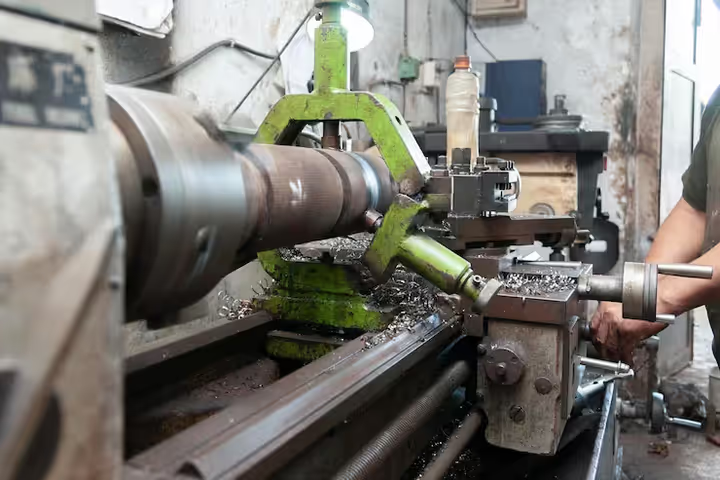
Die Casting Machines: Insights Into Casting Processes, Materials and Applications
Die Casting Machines are industrial systems used to produce metal components by forcing molten metal into a shaped mold under controlled pressure.
The process is widely associated with aluminum, zinc, and magnesium alloys and is used for components that require defined shapes, repeatable dimensions, and relatively smooth surfaces. Die casting machines combine a metal injection system, mold, clamping mechanism, temperature controls, and monitoring equipment to convert molten metal into finished cast shapes.
Context
What Are Die Casting Machines?
Die casting machines are mechanical systems designed to inject molten metal into a reusable metal mold, commonly called a die. Pressure keeps the molten material inside the mold until it solidifies sufficiently to form the required component.
The process differs from gravity casting because the molten metal is driven into the mold using pressure. This allows the metal to fill relatively detailed cavities and can support the production of components with thin sections, ribs, holes, and other geometric features.
Die casting has been used in metal manufacturing for more than a century. Its development was closely connected with the growing need for repeatable metal components in industries such as automotive manufacturing, consumer products, electronics, and machinery.
How Die Casting Works
A typical cycle begins when an appropriate alloy is melted in a furnace or holding system. A measured quantity of molten metal is then transferred to the injection chamber.
The machine pushes the molten metal into the die at controlled speed and pressure. After the cavity fills, pressure may be maintained for a short period while the metal begins to solidify. The die then opens, and an ejector mechanism removes the casting.
A simplified cycle includes:
- Metal melting and temperature control
- Metal transfer into the injection system
- High-speed filling of the mold
- Pressure application during solidification
- Die opening
- Component ejection
- Trimming and inspection
The exact sequence depends on machine design, alloy characteristics, mold geometry, and production requirements.
Main Types of Die Casting Machines
Die casting machines are generally divided according to the method used to inject molten metal into the mold.
Hot-chamber machines keep the injection mechanism in contact with molten metal or closely integrated with the metal-holding system. They are commonly associated with alloys such as zinc that can be processed at relatively lower temperatures.
Cold-chamber machines use a separate shot chamber. Molten metal is transferred into the chamber before a plunger forces it into the die. This arrangement is commonly used for aluminum and magnesium alloys.
There are also differences in machine operation and drive technology. Hydraulic systems have traditionally been widely used, while modern equipment may incorporate electric or hybrid drive systems for specific machine functions.
| Machine Type | General Feature | Common Material Applications |
|---|---|---|
| Hot-chamber | Injection system connected with molten metal area | Zinc and selected low-melting alloys |
| Cold-chamber | Molten metal transferred into a separate shot chamber | Aluminum and magnesium alloys |
| Hydraulic | Uses hydraulic power for major machine movements | Various industrial applications |
| Electric | Uses electric drives for selected machine functions | Precision-oriented production |
| Hybrid | Combines hydraulic and electric technologies | Various production environments |
Importance
Why Die Casting Machines Matter
Die casting machines are important because they allow manufacturers to produce large numbers of similar metal components using reusable dies. The process can create complex shapes while reducing the need for extensive machining after casting in suitable applications.
The technology is used in components found in vehicles, electrical equipment, household products, industrial machinery, lighting equipment, and electronic products. The dimensions and material characteristics required vary considerably between applications.
Applications in Different Industries
Automotive manufacturing is a major application area for die casting. Components such as housings, brackets, structural parts, covers, and selected powertrain components can be produced using die casting techniques.
Electronics and electrical equipment can also use die-cast housings and structural components. In industrial equipment, cast components may be used for enclosures, mechanical supports, covers, and other engineered parts.
Common application areas include:
- Automotive components
- Electrical enclosures
- Electronics housings
- Industrial machinery
- Lighting components
- Consumer equipment
- Hardware components
- Heat-management components
Factors Affecting Casting Quality
Casting quality depends on several interconnected factors. Metal temperature, die temperature, injection speed, injection pressure, cooling conditions, lubrication, and mold design can all influence the final component.
Gas trapped inside the cavity can contribute to porosity. Incorrect filling conditions can produce incomplete sections, surface defects, or dimensional variation. Die wear and improper temperature control can also affect production results.
Quality inspection may include dimensional measurement, visual inspection, density evaluation, X-ray examination, pressure testing, or other methods depending on the component's intended use.
Recent Updates
Automation and Digital Control
Between 2024 and 2026, die casting technology has continued to incorporate automation, sensors, data collection, and digital control systems. Modern machines can monitor parameters such as injection pressure, position, velocity, temperature, and cycle conditions.
Machine controllers can record production data for individual cycles. This information can help engineers identify changes in process conditions and investigate variations between batches.
Larger Casting Systems
Another significant development has been increased interest in large-scale die casting for automotive structures and other applications. Larger machines can produce substantial components that may reduce the number of individual cast parts required in certain designs.
This approach requires careful consideration of machine capacity, die dimensions, metal flow, thermal management, clamping force, and component inspection. It is not suitable for every type of component.
Energy Management
Energy use is an important consideration because die casting involves metal melting, mold heating, hydraulic or electric movement, cooling, and auxiliary equipment.
Recent machine designs increasingly incorporate improved drive control, heat management, monitoring, and energy-data collection. Electric and hybrid systems can provide different approaches to controlling machine movements and hydraulic demand.
Sensors and Process Monitoring
Sensors are increasingly used to monitor die temperature, hydraulic pressure, injection movement, metal temperature, and other process conditions. Data from these sensors can be combined with machine-control software.
Some production systems also use machine vision and automated inspection to examine cast components. Such systems can identify selected surface or dimensional characteristics without relying entirely on manual inspection.
Die Design and Simulation
Computer-aided engineering has become an important part of die casting preparation. Simulation software can model metal flow, filling behavior, solidification, cooling, and potential defect areas before physical production begins.
Engineers can use these analyses to examine gate locations, cooling channels, vents, and other design factors. Simulation results depend on the quality of the material data, machine parameters, and assumptions used in the model.
Laws or Policies
Indian Regulatory Context
In India, die casting facilities can be subject to several areas of industrial regulation. Requirements may relate to workplace safety, machinery, electrical installations, environmental management, fire protection, and handling of molten metals.
The Occupational Safety, Health and Working Conditions Code, 2020 provides a national framework covering workplace health and safety, subject to its applicability and implementation framework. State-level authorities may also have requirements concerning industrial establishments.
Worker and Machine Safety
Die casting involves high temperatures, moving machinery, pressurized systems, molten metal, lubricants, electrical equipment, and cooling systems. Appropriate safeguards are therefore important for preventing contact with hazardous areas and controlling operational risks.
Machine guarding, emergency controls, protective equipment, safe operating procedures, electrical protection, and worker training are among the areas that may need attention. Exact requirements depend on the facility, machine configuration, and applicable rules.
Environmental Considerations
Industrial die casting can generate metal residues, used lubricants, particulate matter, wastewater from some processes, and other forms of industrial waste. Facilities may therefore need to follow applicable environmental requirements administered by the Central Pollution Control Board, State Pollution Control Boards, and local authorities.
Waste classification, storage, treatment, disposal, and emissions control depend on the materials and processes used. Facilities should verify applicable requirements according to their location and operating conditions.
Standards and Quality Management
Technical standards can also influence die casting operations. Organizations may refer to relevant Bureau of Indian Standards publications and international standards covering materials, testing, dimensional requirements, quality management, and workplace practices.
The applicable standard depends on the component, alloy, industry, and customer specification. There is no single standard that applies to every die casting operation.
Tools and Resources
Die Casting Simulation Software
Simulation platforms can analyze metal flow, cavity filling, solidification, cooling, and potential defects. These tools are particularly useful during die design and process development.
Measurement Equipment
Common inspection equipment includes coordinate measuring machines, digital calipers, micrometers, surface measurement instruments, temperature sensors, pressure sensors, and hardness-testing equipment. More advanced applications may use X-ray or computed tomography systems to inspect internal characteristics.
Machine Monitoring Systems
Production monitoring platforms can collect cycle data, machine status, temperature readings, pressure information, and maintenance records. These systems can help organize production information and identify changes in operating conditions.
Technical Resources
Useful information can be obtained from:
- Bureau of Indian Standards publications
- Ministry of Labour and Employment resources
- Central Pollution Control Board publications
- State Pollution Control Board websites
- Original machine technical manuals
- Die casting engineering references
- Materials and alloy specification documents
- Industrial safety guidance
These resources should be checked against the specific machine, material, facility, and jurisdiction involved.
FAQs
What are Die Casting Machines used for?
Die Casting Machines are used to produce metal components by forcing molten metal into reusable dies under controlled pressure. They are commonly used for aluminum, zinc, and magnesium alloy components.
How do Die Casting Machines work?
A Die Casting Machine transfers molten metal into an injection chamber and then pushes it into a closed die. Pressure is maintained during the initial solidification stage before the die opens and the component is ejected.
What is the difference between hot-chamber and cold-chamber Die Casting Machines?
Hot-chamber machines keep the injection mechanism integrated with the molten-metal area and are commonly associated with lower-melting alloys. Cold-chamber machines receive molten metal separately before injection and are commonly used for aluminum and magnesium alloys.
Which materials are commonly used in die casting?
Aluminum, zinc, and magnesium alloys are among the commonly used die-casting materials. The selected alloy depends on mechanical properties, density, corrosion behavior, thermal characteristics, component geometry, and application requirements.
What factors affect die casting quality?
Important factors include alloy composition, metal temperature, die temperature, injection speed, pressure, cooling, venting, lubrication, die condition, and mold design. Inspection and process data help identify variations or defects.
Conclusion
Die Casting Machines use controlled pressure to transform molten metal into shaped components through reusable dies. Hot-chamber and cold-chamber systems serve different material and process requirements, while hydraulic, electric, and hybrid technologies provide different approaches to machine movement and control. Recent developments have focused on automation, digital monitoring, larger casting systems, simulation, and energy management. In India, die casting facilities may need to consider workplace safety, environmental protection, machinery safeguards, electrical requirements, and applicable technical standards.